The project develops the first monitoring network of light pollution and atmospheric conditions along the Panama Canal watershed. Its main objective is to characterize how artificial nighttime light is scattered and amplified in the tropical atmosphere, and how these changes in nighttime illumination can influence, according to previous scientific evidence, ecological processes (nocturnal pollinator activity and nocturnal plant physiology) and the water cycle balance (carbon exchange and transpiration). Therefore, in the medium and long term, in operational considerations linked to the environmental management of the basin.
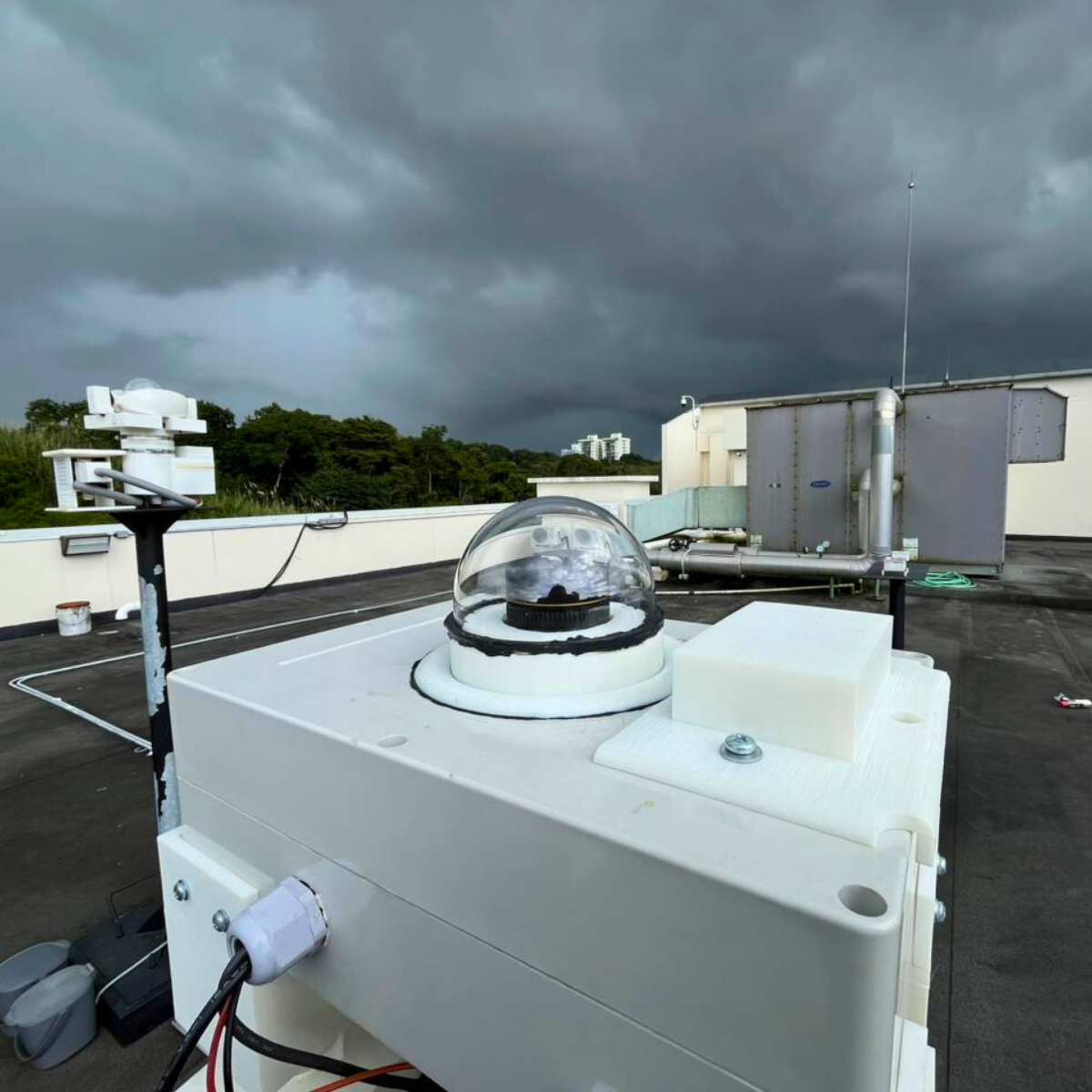
The initiative combines high-precision ground-based instrumentation (multi-channel photometers, spectrometers, all-sky cameras, atmospheric sensors) with remote sensing data from the International Space Station (ISS) and other satellite campaigns. The project integrates photometric, spectral and atmospheric analyses to generate a physical understanding of nighttime illumination in tropical environments, a field where data and methodologies are scarce.
Scope: - Three monitoring substations in the Atlantic, central Canal and Pacific. - Development of tropicalized astronomical domes, electronics and computer control made in Panama. - Modeling of nighttime light brightness, color and scattering, along with aerosol profiles and atmospheric variables. - Integration with ISS images.
Value of the project: generate solid scientific knowledge that will allow establishing modern lighting regulations, reduce environmental impacts and contribute to the sustainable management of the Canal watershed (green route 2050).
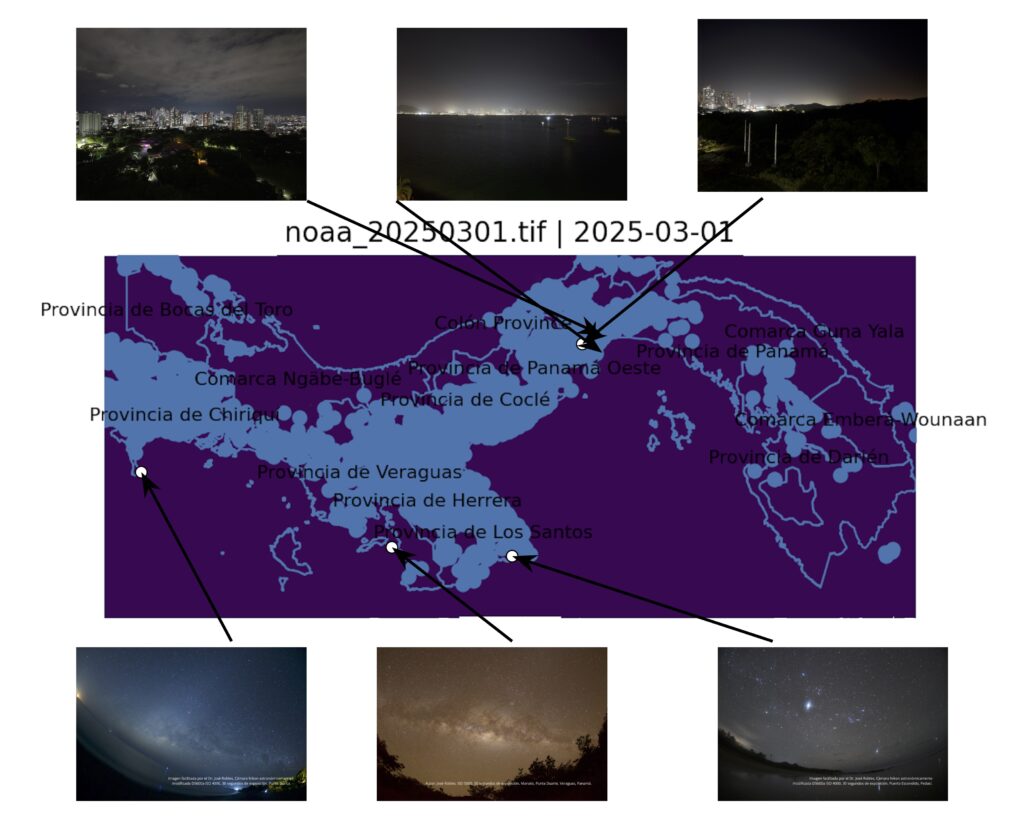
PRELIMINARY RESULTS - Production of the first systematic data of brightness and color of the night sky in Panama, with free international access through the TESS-4C platform:
- Implementation of the first internal nighttime lighting management measures in the research building of the Technological University of Panama, based on photometric criteria and scientific evidence. This progress represents an initial step towards the future adoption of good practices and guidelines for night lighting at the institutional and, potentially, national level.
Expected impact: - To evaluate the effects of artificial lighting on nocturnal pollinators and dependent ecosystems in the Panama Canal watershed. - Define a scientific baseline for future lighting regulations in Panama. - Improve energy efficiency and environmental quality in critical areas of the basin. - Strengthen national capacities in instrumentation, data analysis and remote sensing.
Location
In the route of the Panama Canal: 1) Caribbean entrance, 2) intermediate point (Gamboa) and 3) Pacific.
Collaborations
Smithsonian Institute, Technological University of Panama and Panama City Hall.
Robles, J., Zamorano, J., Pascual, S., Sánchez de Miguel, A., Gallego, J., & Gaston, K. J. (2021). Evolution of Brightness and Color of the Night Sky in Madrid. Remote Sensing, 13(8), 1511. https://doi.org/$10.3390/rs13081511$
Robles Rodríguez, J. L. (2022). The Evolution of light pollution using measurements of night sky brightness and color in Madrid [Doctoral thesis, Universidad Complutense de Madrid]. Docta.
My name is José Robles and I am the project manager of the first light pollution station in the Republic of Panama. We study the brightness and color of the night sky along the Panama Canal watershed using high precision photometric and spectrometric measurements.
We work with professional instrumentation: astronomical cameras in Johnson U, B, V, R and I bands, four-channel photometers, spectrometers and our own acquisition systems. We design and build our own hardware, including mini-domes for tropical climates and electronic circuitry made in Panama.
Our goal is to understand how artificial nighttime light, measured at multiple wavelengths, alters nocturnal pollinator activity, affects forest growth and plant respiration, and eventually modifies the water cycle in the Canal watershed; it is preventive research based on quantitative evidence.
Dr. José Robles, principal investigator of the project at INDICATIC AIP
My name is Kevin Chaw, I am an electronics engineer and laboratory manager for the light pollution project in Panama. I coordinate the use of monitoring instruments, the collection and processing of geospatial data, as well as the development of models that assess the environmental and social impact of light pollution.
Kevin Chaw, Lab Manager, INDICATIC AIP
My name is Katherine Gálvez L., I am an Electronic Electrical Engineer and Technical Assistant at INDICATIC AIP. Within the Light Pollution Project, I have collaborated in the design and printing of 3D models and electronic circuit boards. This experience has allowed me to grow in the scientific field, specifically, in electronic applications for astronomical and environmental monitoring purposes. In addition, being closer to high-tech equipment used for spectral analysis and deep sky astrophotography has motivated me to continue building a more robust professional and academic profile.
Katherine Gálvez, Technical Engineering Assistant at INDICATIC AIP
My name is José Jaén, I am a software development engineer. In the project of the first light pollution monitoring station in the Panama Canal watershed, I develop scientific controllers in operating multiplatforms and communications systems for photometric and spectrometric instrumentation. Additionally, I collaborate in 3D printing for the adaptation of light-sensitive sensors to tropical latitudes.
Robles, J., Zamorano, J., & Pascual, S. (2026). Multi-band zenith amplification factor of Madrid night sky brightness under overcast conditions.Journal of Quantitative Spectroscopy and Radiative Transfer, 355, Article 109886. See here
Robles Rodríguez, J. L. (2022). The Evolution of light pollution using measurements of night sky brightness and color in Madrid [Doctoral thesis, Universidad Complutense de Madrid]. Docta. See here
International Dark-Sky Association Pittsburgh Chapter (2021). Blue skies over Madrid, but not during the day.
Robles, J., Zamorano, J., Pascual, S., Sánchez de Miguel, A., Gallego, J., & Gaston, K. J. (2021). Evolution of Brightness and Color of the Night Sky in Madrid. Remote Sensing, 13(8), 1511. See here
Supervised work
Title: Interoperability, cryptography and télécommunication de la première station de light pollution monitoring in panama
Author: Alexandre Olivié
University: École Nationale Supérieure d'Électronique, Informatique, Télécommunications, Mathématique et Mécanique de Bordeaux
ENSEIRB-MATMECA of Bordeaux INP (Institut National Polytechnique Bordeaux).
Study center: Telecommunication - option networks, security and connected object







 Español
  English
  Francais